
 English


Views: 0 Author: Site Editor Publish Time: 2026-03-10 Origin: Site


Ever struggled with a stuck cork? A stubborn cork can ruin a perfect evening and damage your wine bottle.
Removing it safely is harder than it seems. In this guide, you will learn practical ways to get a cork out of any wine bottle. We will cover tools, emergency fixes, and safe techniques for every scenario.
The safest and most reliable method for removing a cork remains the correct use of a corkscrew. Strength is less important than control, alignment, and patience, and proper technique dramatically reduces cork failure.
Before inserting any tool, focus on preparation. Place the wine bottle upright on a firm, flat surface so it remains stable throughout extraction. Remove the foil cleanly just below the lip of the bottle using the small blade on your corkscrew, ensuring there are no jagged metal edges that could interfere with pouring. Hold the bottle firmly at its base rather than gripping the neck, because this reduces wobbling and prevents uneven pressure. Many cork failures occur simply because the wine bottle shifts during pulling, creating lateral stress on the cork.
Proper positioning may seem minor, but it directly impacts cork integrity. When pressure is applied straight upward rather than at an angle, the cork remains intact and the glass neck is protected.
A double-hinged waiter’s corkscrew is widely considered the professional standard for opening a wine bottle because it offers leverage and precision. Insert the worm directly into the center of the cork and twist slowly until only one spiral coil remains visible above the surface, which prevents piercing the bottom of the cork. Once inserted, position the first hinge notch on the bottle lip and lift the cork halfway out. Then reposition to the second hinge and pull straight upward with steady, controlled force until the cork slides free.
This two-step leverage system reduces cork breakage by distributing pressure gradually. Pulling slowly is critical, because sudden force increases crumble risk, especially in older wine bottles.
If half the cork comes out cleanly while the remaining portion stays lodged in the neck, resist the urge to forcefully dig at it. Remove loose debris and inspect the remaining cork surface. Reinsert the corkscrew at a slight angle into the solid portion of cork, twisting deeply to create a secure grip. Pull slowly and steadily without rocking sideways. If the cork continues to split, switching to a two-prong opener is often safer than attempting repeated screw insertions.
Cork breakage is common in bottles aged more than ten years (validation required), particularly if stored upright. Remaining calm and adjusting tools usually resolves the issue.
An Ah-So opener is specifically designed for fragile or aged corks. Slide the longer prong gently between the cork and the glass, followed by the shorter prong on the opposite side. Rock the prongs downward gradually until fully inserted, then twist and pull upward slowly. Because this tool grips the cork from the sides rather than piercing its center, it reduces the chance of fragmentation and is ideal for valuable or mature wine bottles.
Serious wine collectors often keep both a corkscrew and an Ah-So opener available to handle unpredictable cork conditions.
If extraction attempts repeatedly fail and the cork continues to crumble, pushing it into the wine bottle may be the most practical solution. Use the handle of a wooden spoon or a thin dowel to press firmly and evenly until the cork drops fully into the bottle. Although this method sacrifices presentation, it preserves the wine itself. Afterward, decant through a fine strainer or cheesecloth to remove cork fragments.
While inelegant, pushing the cork inside does not harm the wine during short exposure time (validation required).
When a corkscrew is unavailable, a screw and pliers can replicate its mechanics. Drive a long screw deeply into the cork, leaving about one inch exposed. Grip the screw head firmly with pliers and pull upward steadily while maintaining vertical alignment. This method provides strong grip and works well in emergency situations, though it requires basic tools and careful handling.
In cases where the cork feels swollen and immovable, running warm tap water over the neck of the wine bottle for thirty seconds may slightly expand the glass and soften cork grip. Avoid direct flame on cold glass, as rapid temperature change may cause cracking. After warming, dry the bottle and attempt extraction again using steady pressure.
Restaurants should keep both waiter’s corkscrews and Ah-So openers accessible during service to prevent delays caused by fragile corks.
Improvised methods can work when tools are missing, though they carry higher risk and should be used cautiously.
Insert a screw deeply into the cork and pull using pliers or a hammer claw. Keep the motion vertical and steady to avoid splitting the cork or damaging the wine bottle.
Insert a key or knife blade at a 45-degree angle, twist slowly, and pull upward gradually. The key must penetrate deeply enough to grip solid cork; otherwise, crumbling may occur.
Press the cork downward with a wooden spoon handle and decant through a strainer. This method is effective in casual settings but commits you to finishing the bottle.
Wrap the base of the wine bottle in a thick towel and tap gently against a firm wall, allowing internal pressure to push the cork outward gradually. This method carries glass breakage risk and should only be used as a final option.
Emergency cork removal techniques may solve the problem but are unsuitable for high-value or aged wine bottles.
Old corks deteriorate over time due to moisture loss. Slow extraction or push-and-decant methods are typically safest.
Swollen corks often result from heat exposure. Warm water around the neck and steady leverage usually resolve the issue.
If the cork remains lodged in the neck, use a spoon or chopstick to push it fully inside before pouring carefully.
Decant slowly through a fine mesh filter and avoid shaking the wine bottle to prevent sediment disturbance.
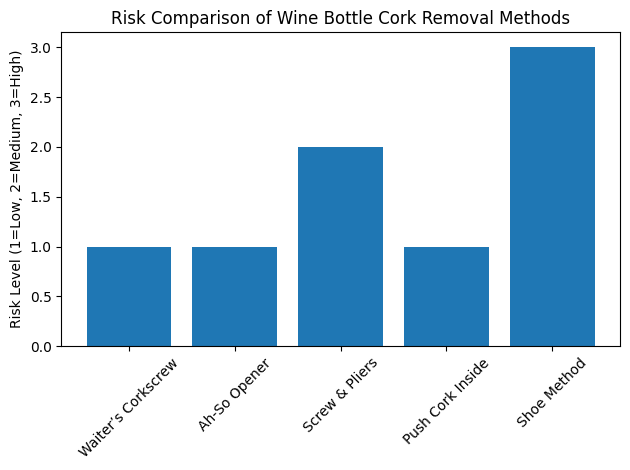
Method | Best For | Risk Level | Recommended Use |
Waiter’s Corkscrew | Standard cork removal | Low | Daily use |
Ah-So Opener | Old corks | Low | Aged wines |
Screw & Pliers | No corkscrew | Medium | Emergency |
Push Cork Inside | Broken cork | Low | Casual setting |
Shoe Method | No tools | High | Last resort |
This comparison helps you select the most appropriate approach depending on the situation and wine value.
Prevention reduces future frustration. Store each wine bottle horizontally so the cork remains moist and flexible. Avoid excessive heat exposure, because temperature fluctuation causes cork expansion and contraction that weakens structure. Use high-quality double-hinged corkscrews that provide better leverage and stability. Inspect cork condition visually before pulling to detect cracks or dryness.
Prevention Strategy | Purpose | Result |
Horizontal Storage | Keeps cork moist | Reduces crumble risk |
Stable Temperature | Prevents swelling | Easier extraction |
Quality Corkscrew | Improves leverage | Cleaner removal |
Cork Inspection | Identifies weakness | Adjust technique early |
Retailers can reduce post-sale complaints by educating customers on proper horizontal wine bottle storage.
Always pull vertically rather than twisting sideways, because lateral force weakens cork structure and increases fracture risk. Never strike the bottle neck directly, as glass fracture risk rises sharply with impact. Keep hands clear of sharp blades when cutting foil. Decant whenever cork fragments appear to maintain wine clarity and safety.
Wine preservation systems insert a needle through the cork, allowing wine extraction without removing it. The cork reseals naturally afterward, preserving remaining wine for extended periods (validation required). Collectors and restaurants benefit from reduced waste and greater flexibility in serving premium labels.
Fine-dining establishments can increase per-bottle revenue by pairing preservation systems with by-the-glass premium wine programs.
Knowing how to get a cork out a wine bottle transforms an inconvenient moment into a manageable task, especially when the bottle itself is manufactured to high structural standards by trusted producers such as HUAYUE GLASS LIMITED. Whether you rely on a waiter’s corkscrew, an Ah-So opener, an emergency screw-and-pliers solution, or a push-and-decant approach, the objective remains consistent: protect the wine bottle, preserve the wine, and avoid unnecessary damage to both cork and glass. With proper technique, careful handling, and preventive storage habits, even the most stubborn cork can be removed safely and confidently while maintaining the integrity, durability, and presentation quality expected from a professionally crafted wine bottle supplied by HUAYUE GLASS LIMITED.
A: The safest way to open a wine bottle is using a double-hinged corkscrew and pulling straight upward slowly.
A: Reinsert the corkscrew into the remaining cork inside the wine bottle and pull gently without twisting sideways.
A: Yes, you can push the cork into the wine bottle and decant through a strainer to remove debris.
A: Corks in an old wine bottle dry out over time, which makes them fragile and prone to breaking.
A: If cork falls inside the wine bottle, decant carefully and filter out fragments before serving.


