
 English


Views: 0 Author: Site Editor Publish Time: 2026-07-02 Origin: Site


The physical weight, clarity, and texture of a spirit bottle serve as the first tactile touchpoint between a consumer and a premium spirit, heavily influencing perceived value and taste anticipation before the liquid is ever tasted. Distilleries and brand owners must balance the desire for striking, differentiated aesthetic design with strict operational constraints. These constraints include filling line compatibility, unit economics, closure integrity, and supply chain reliability. A beautifully designed vessel that tips over on a high-speed conveyor or fails to seal properly quickly becomes an operational liability. This guide provides a systematic, technical framework for evaluating and selecting packaging that satisfies both brand positioning requirements and logistical realities.
Glass quality (flint vs. super flint) and base weight directly dictate premium positioning but exponentially impact freight costs, carbon footprint, and pallet density.
The decision between stock and custom molds hinges on volume thresholds, speed-to-market requirements, and the ability to differentiate through advanced labeling and tactile enhancements.
Bottle geometry must be evaluated against filling line constraints, back-bar LED visual refraction, labeling machine tolerances, and bartender ergonomics (grip, slip-resistance, and speed rail compatibility).
Closure compatibility—specifically the tolerance between the neck finish and the chosen cork or cap—is a critical failure point that requires rigorous physical testing.
Consumers rely on established visual cues to navigate liquor shelves. Whiskey and bourbon traditionally utilize stout, heavy-based silhouettes that communicate heritage and substance. Vodka and gin often lean toward tall, slender, elegant profiles that suggest purity and crispness. Tequila and mezcal frequently employ rustic, artisanal shapes or heavily textured glass to emphasize traditional production methods. Recognizing these category norms is the first step in packaging design.
Deciding when to conform to these norms versus when to disrupt the shelf requires careful analysis. Conforming ensures immediate consumer recognition. This helps new brands trying to establish a foothold in a crowded category. Disrupting the category with an unconventional shape captures attention but risks confusing the consumer about the liquid inside. A successful strategy often involves adopting the general silhouette of the category while introducing distinct geometric facets, unique neck profiles, or proprietary textures to stand out.
Spirit Category | Traditional Silhouette | Consumer Perception | Common Disruptive Tactics |
|---|---|---|---|
Whiskey / Bourbon | Stout, heavy base, broad shoulders | Heritage, age, substance | Asymmetrical facets, ultra-wide profiles |
Vodka / Gin | Tall, slender, minimal base | Purity, modernism, crispness | Colored glass gradients, extreme minimalism |
Tequila / Mezcal | Rustic, textured, irregular | Artisanal, handcrafted, earthy | Sleek geometric decanters, heavy metal stoppers |
Rum | Curved, bulbous, nautical nods | Tropical, historical, rich | Sharp angular lines, minimalist typography |
Glass weight heavily influences the perception of luxury. A thick glass base, known as a punt, adds substantial physical weight to the vessel. When a consumer picks up a heavy container, they subconsciously associate that heft with high quality and premium craftsmanship. Adding glass mass must be done strategically to maintain the proper internal volume while maximizing the external footprint.
Back-bar optimization dictates how a product performs in on-premise environments. Bottles displayed in bars and restaurants sit on shelves illuminated from below or behind by LED lighting. Geometry, facet cuts, and exceptional glass clarity work together to refract this light. This creates a glowing effect that maximizes back-bar stand-out. A well-designed vessel acts as a lens, amplifying the color and clarity of the spirit.
Brands should also consider the secondary lifecycle of their packaging. Designing for collectibility, upcycling, or secondary home-bar decanter use extends brand touchpoints long after the original liquid is consumed. Heavy stoppers, wide necks, and elegant silhouettes encourage consumers to keep and reuse the container.
Despite the benefits of heavy glass, diminishing returns exist. Excessive weight drastically increases environmental impact, carbon footprints, and global shipping costs. Brands must find the equilibrium between a premium tactile experience and sustainable, efficient logistics.
Off-the-shelf molds offer significant advantages for new product launches, limited releases, or brands operating with strict capital constraints. Stock options require lower Minimum Order Quantities (MOQs). This allows distilleries to manage cash flow and warehouse space effectively. They also offer much faster lead times, bypassing the months required for custom mold engineering, prototyping, and testing.
Using a stock shape does not mean sacrificing premium positioning. Brands can elevate standard vessels using high-end label materials. Welded materials, heavily textured papers, and metallic foils completely transform a basic cylinder. Tactile varnishes, custom neck bands, and unique closures further differentiate the product, making a stock container look entirely bespoke.
Custom tooling becomes economically viable when production volumes reach specific thresholds. This typically starts around 20,000 to 30,000 units depending on the glass manufacturer. At this scale, the upfront cost of mold creation is amortized across enough units to make the per-bottle cost competitive with stock options.
The primary advantage of a custom mold is the long-term brand equity of owning a proprietary silhouette. A unique shape becomes a recognizable trademark, instantly identifiable even without a label. The timeline for custom development requires patience and strict project management.
Concept and 3D Design: Drafting the initial geometry and calculating internal volume displacement.
Lucite Prototyping: Machining a solid acrylic model to evaluate physical ergonomics and shelf presence.
Pilot Mold Production: Cutting a single-cavity metal mold to produce the first run of actual glass samples.
Line Testing: Running the pilot samples through the automated filling, capping, and labeling equipment to identify failure points.
Full-Scale Manufacturing: Cutting the multi-cavity production molds and scheduling the main glass run.
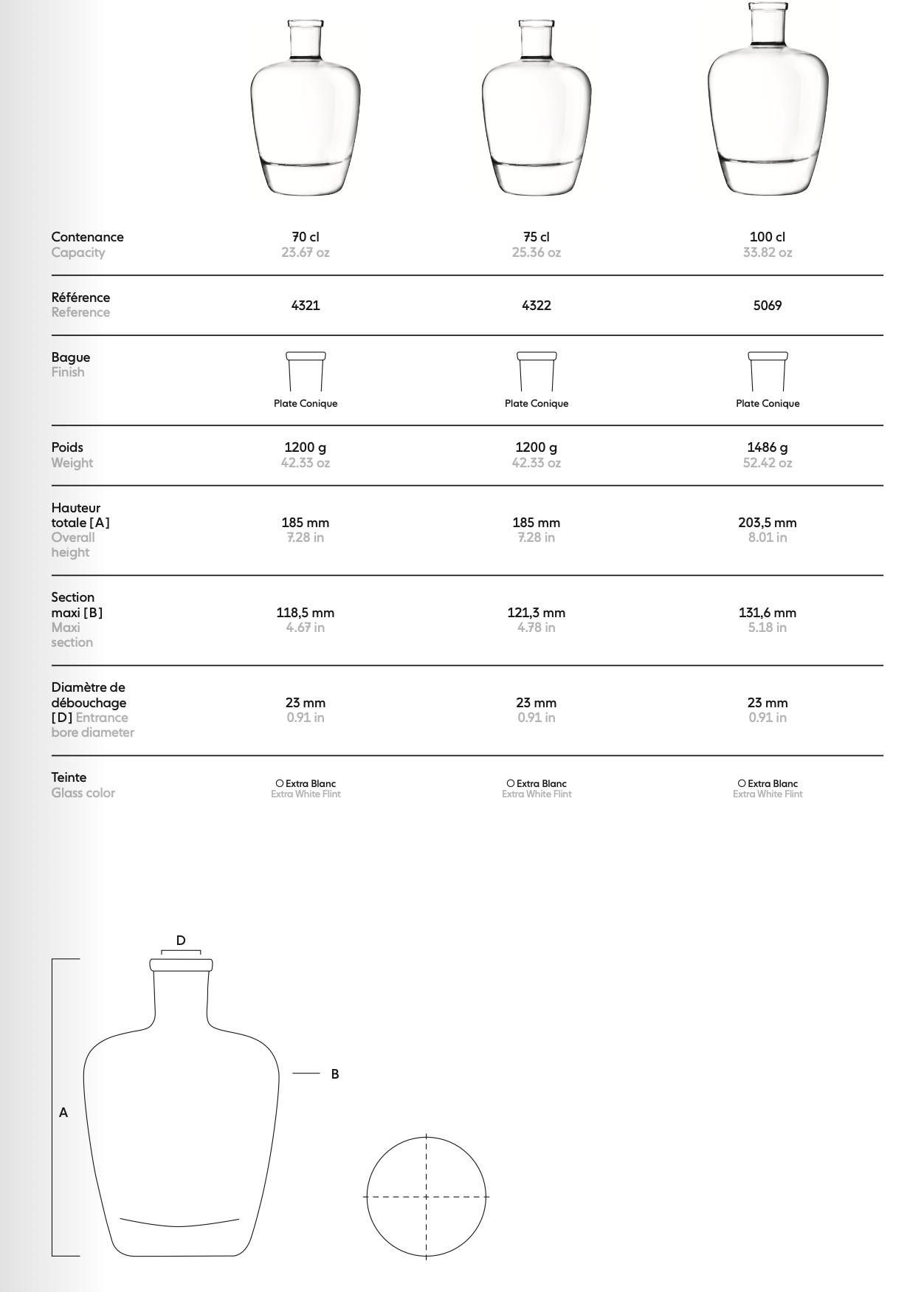
The raw materials and manufacturing processes dictate the final appearance of the glass. Standard flint glass is clear but often retains a faint greenish or grayish tint due to trace iron impurities in the silica sand. Super flint, or extra clear glass, undergoes rigorous refinement to remove these impurities. This results in crystal-clear transparency that is essential for showcasing premium clear spirits like vodka, gin, or silver tequila.
Antique green or amber glass is frequently used for aged spirits or botanical liqueurs. These colors provide UV protection, preventing light strike from degrading the liquid's flavor profile over time.
Glass Type | Visual Characteristics | Best Application | Cost Implication |
|---|---|---|---|
Standard Flint | Clear with slight green/gray tint | Mid-tier spirits, dark liquors | Baseline cost |
Super Flint | Crystal clear, high brilliance | Premium clear spirits (Vodka, Gin) | Premium cost |
Amber / Green | Dark, UV-blocking | Aged whiskey, botanical liqueurs | Baseline to mid-tier cost |
PCR Blended | Slight color variation, minor seeds | Eco-conscious brands | Varies based on PCR percentage |
Integrating Post-Consumer Recycled (PCR) glass is increasingly important for eco-conscious brands. High PCR content can introduce slight color variations or minor imperfections like seeds and blisters into the glass. Brands must balance their sustainability goals with the visual clarity demands of their target market.
Bottle shape directly impacts retail shelf-space optimization. Excessively wide or unusually shaped containers may not fit on standard retail shelving. This frustrates retailers and limits distribution opportunities. Packing density is also affected. Irregular shapes leave empty space inside shipping cartons, reducing the number of units per pallet and increasing shipping costs per unit.
Bartender ergonomics dictate on-premise success. A neck length that allows for rapid, secure gripping is essential in high-volume environments. The center of gravity must facilitate effortless pouring. The base diameter must be compatible with standard bar speed rails. A beautiful design that a bartender cannot easily grab, pour, or store will quickly be relegated to the bottom shelf.
Achieving even glass distribution in heavy-based designs presents significant manufacturing challenges. As molten glass is blown into the mold, gravity pulls the material downward. If not precisely controlled, this results in uneven wall thickness, creating structural weak points or optical distortion.
Different punt designs impact the overall volume and height of the vessel. A deep punt displaces liquid, requiring a taller or wider container to hold the standard 700ml or 750ml volume. Structural engineering must be carefully calculated to ensure the final dimensions remain compatible with filling equipment and secondary packaging.
The geometry of the glass dictates what type of label can be successfully applied. Compound curves, extreme tapers, or spherical shapes cause paper labels to wrinkle, bubble, or flag during automated application. Flat panels or slight, uniform curves are required for high-speed, flawless labeling.
Label material must be matched to the spirit type and its expected usage environment. Whiskey and bourbon often utilize standard uncoated, heavily textured papers that convey craftsmanship. Clear spirits frequently stored in freezers or submerged in ice buckets require moisture-resistant, synthetic welded materials to prevent the label from disintegrating.
Aesthetic embellishments add premium tactile depth. High-build UV varnishes create raised, glossy areas that catch the light. Hot foil stamping adds metallic brilliance. Debossing creates physical depressions in the paper, inviting consumers to run their fingers over the label.
Direct-to-glass decoration bypasses paper labels entirely, offering a highly durable and premium aesthetic. Screen printing applies ceramic inks directly to the glass, which are then baked on for permanence. Acid etching and frosting create a matte, translucent finish that diffuses light beautifully.
For brands seeking the pinnacle of bespoke packaging, sourcing a Custom Decal Embossed Logo Spirit Bottle For Whisky provides a permanent, tactile brand signature. Embossing the glass mold with the brand's crest or typography creates a physical feature that cannot be replicated by standard labels. This establishes a profound sense of authenticity and heritage.
The interface between the glass neck finish and the closure is a critical failure point. Bartop finishes require precise internal bore tolerances. If the bore is too wide, the cork will leak or evaporate, increasing the angel's share. If the bore is too tight, the cork will be impossible to insert on the bottling line or difficult for the consumer to remove.
Natural corks offer traditional appeal but carry the risk of cork taint (TCA) and natural variation. Micro-agglomerated corks provide consistent density and eliminate TCA risks while maintaining a traditional look. Synthetic corks offer perfect consistency and zero flavor transfer, though they lack the romanticism of natural wood.
High-altitude transit presents another risk. Changes in air pressure cause bartop closures to pop up or completely dislodge if the friction fit is not calibrated correctly.
High-volume or specific category applications often utilize threaded finishes. Roll-on Pilfer-Proof (RoPP) aluminum caps require specialized capping equipment that threads the aluminum directly onto the glass finish. This provides an excellent seal and built-in tamper evidence. Standard continuous thread (CT) closures are simpler but require secondary tamper-evident solutions.
Secondary tamper evidence includes heat-shrink bands, adhesive tax stamps, or wax dipping. Wax dipping offers a highly artisanal, premium look. However, it creates a massive operational bottleneck, as it typically requires manual application and cooling time.
A packaging design must be audited against the physical constraints of the automated filling line. Maximum height clearances under fill nozzles and capping heads are rigid limits. Conveyor belt stability is a major concern for top-heavy, narrow-base, or asymmetrical designs. These are prone to tipping over when changing speeds or moving through star-wheels.
Star-wheels guide containers through rinsing, filling, and capping stations. They must be custom-machined to match the exact profile of the glass. Complex shapes require expensive, custom change-parts and increase the time needed to switch the line between different products.
The physical dimensions of the glass dictate carton size, which in turn dictates pallet configuration. A design that is unusually tall or wide reduces the number of units that fit on a standard pallet. This inefficiency cascades through the supply chain, increasing warehouse storage costs and driving up the landed freight cost per unit.
Breakage risks during transit must be mitigated through proper secondary packaging. Heavy-based or angular designs require custom corrugated partitions to prevent glass-to-glass contact and absorb impact during shipping.
Vetting glass manufacturers requires strict attention to quality control standards. Acceptable Quality Limit (AQL) agreements must be established to define the tolerance for defects such as seeds, blisters, uneven walls, or mold seam misalignments. Historical reliability and communication are just as important as technical capability.
Supply chain disruptions are a constant threat. Brands mitigate these risks by dual-sourcing critical components or maintaining strategic safety stock in domestic warehouses to buffer against international shipping delays.
Request physical glass samples from multiple suppliers to evaluate weight, clarity, and ergonomic feel in person.
Conduct rigorous line trials with water or dummy liquid to test conveyor stability, star-wheel compatibility, and labeling accuracy.
Test closure tolerances under extreme temperature fluctuations and simulate high-altitude transit to ensure seal integrity.
Audit the primary packaging supplier's quality control documentation and establish firm AQL standards before committing to a production run.
A: Global standards vary by region. The US market traditionally uses 750ml, while the EU and UK standard is 700ml. Common variations include 1L formats for on-premise bar use and 50ml miniatures. Recent TTB regulatory updates now allow the 700ml format to be sold in the US, simplifying global inventory for international brands.
A: Standard glass containers typically weigh between 400g and 600g empty. Ultra-premium, heavy-base designs meant to convey luxury and substantial physical heft can easily exceed 800g to 1000g empty, significantly impacting shipping logistics.
A: Standard flint glass is clear but may exhibit a slight greenish or grayish tint due to iron impurities in the sand. Super flint undergoes additional refinement and utilizes higher-quality raw materials to remove these impurities, resulting in crystal-clear transparency ideal for premium clear liquids.
A: You must precisely match the specific GPI or GCMI neck finish code of the glass with the closure manufacturer's specifications. Beyond matching codes, you must conduct physical pull-force testing, inversion leak tests, and temperature fluctuation tests to ensure the tolerance remains tight under stress.
A: Typical industry MOQs for custom molds range from 10,000 to 30,000 units per run. This threshold depends heavily on the specific glass manufacturer, the complexity of the mold, and the total weight of the glass being produced.
A: Irregular shapes, extreme tapers, or excessive heights reduce the number of units per carton and cartons per pallet, directly increasing the landed freight cost per unit. Additionally, certain shapes perform better under condensation; narrow bases or tapered bottoms slide into ice buckets much easier than wide, blocky designs.


