
 English


Views: 0 Author: Site Editor Publish Time: 2026-07-03 Origin: Site


The physical packaging of a spirit is the first tangible touchpoint for consumers, but for distilleries and brand owners, it represents a complex matrix of supply chain logistics, branding, and production variables. Brands frequently design packaging in a vacuum, leading to critical failures on the filling line, skyrocketing shipping costs due to poor pallet utilization, or delays caused by unrealistic glass manufacturing tolerances. Successfully launching a product requires evaluating a spirit bottle not just as a design asset, but as a highly technical component. This guide breaks down the operational realities of bottle sizes, geometric shapes, custom versus stock tooling, and risk mitigation strategies prior to mass production. You must align your packaging choices with your production capabilities. A beautiful container means nothing if it shatters during transit or jams your labeling machine. We will explore how to bridge the gap between aesthetic ambition and factory floor reality.
Operational Compatibility Dictates Design: The dimensions and weight of your chosen bottle must align strictly with your existing filling equipment, labeling machines, and secondary packaging constraints.
Global Compliance Impacts Sizing: Selecting between 700ml and 750ml capacities requires forecasting your target markets, as regulatory standards dictate legal fill volumes across different regions.
Custom vs. Stock Trade-Offs: While custom molds build proprietary brand equity, they introduce significant Minimum Order Quantities (MOQs), extended lead times, and upfront tooling costs compared to off-the-shelf stock options.
Total Landed Cost Matters More Than Unit Price: A bottle’s shape and glass weight directly influence freight efficiency, breakage rates, and closure compatibility, fundamentally altering the final cost of goods sold (COGS).
Establishing the baseline tension between creating a visually disruptive package and maintaining a viable cost-per-unit requires a hard look at your production floor. A successful bottle must survive the rigorous supply chain and run efficiently on automated filling lines. Designing a striking container fails if it cannot withstand the lateral pressure of a star wheel or the top-load weight of a stacked pallet. You have to balance shelf impact with production reality.
Analyze industry-standard visual cues before finalizing a silhouette. Stout, heavy-based bottles traditionally signal premium rums or aged bourbons. Tall, slender profiles dominate the vodka and gin categories. Breaking category norms can capture market share, but it carries inherent risks. Consumers rely on these visual shortcuts to navigate crowded retail shelves. If your aged whiskey looks like a botanical gin, you create friction at the point of purchase.
The aesthetic psychology of silhouettes plays a massive role in consumer perception. Tall, elegant lines convey premium status, luxury, and refinement. They draw the eye upward on the retail shelf, often commanding a higher perceived value. Conversely, stout, angular profiles evoke heritage, tradition, and craftsmanship. These structural, bold designs are heavily favored in the craft whiskey and bourbon sectors, where consumers associate physical weight with liquid quality.
Conducting competitive benchmarking requires the two-step shelf test. First, select a bottle that is immediately recognizable by spirit type to prevent consumer confusion. Second, ensure it remains unique enough to stand out from direct competitors. You achieve this through subtle design accents, varying glass weight, or distinct color choices. A minor adjustment to the shoulder angle or the neck length can differentiate your product without alienating the target demographic.
Defining the total landed cost is mandatory before approving any design. Do not look solely at the invoice from the glass manufacturer. Evaluate bottle costs using a comprehensive formula. Calculate the unit price plus inbound freight. Add the closure cost and secondary packaging requirements. Finally, factor in projected breakage and loss rates to find your true cost. A cheap bottle that breaks at a five percent rate on the line is far more expensive than a premium bottle with a zero percent failure rate.
Silhouette Type | Primary Spirit Categories | Consumer Perception | Production Considerations |
|---|---|---|---|
Tall & Slender | Vodka, Gin, Liqueurs | Modern, elegant, refined | Prone to tipping on high-speed conveyors; requires precise star wheel timing. |
Stout & Heavy-Based | Bourbon, Rum, Single Malt | Heritage, substantial, crafted | Excellent line stability; higher freight costs due to increased glass weight. |
Square / Rectangular | Blended Whiskey, Specialty | Bold, disruptive, structured | Sharp corners create thin glass spots; requires specialized label application. |
Bell / Teardrop | Cognac, Tequila, Premium Blends | Artisanal, luxurious, fluid | Compound curves make paper label application highly difficult without wrinkling. |
Navigating global volume standards requires understanding the regulatory landscape. Historically, 750ml served as the standard in the US market. Meanwhile, 700ml dominates the EU and UK. Recent regulatory changes by the TTB now allow 700ml sizes in the US. This shift offers massive supply chain benefits. Adopting a universal 700ml standard streamlines global distribution and reduces inventory complexity. You no longer need to run separate glass molds, labels, and cartons for domestic versus export markets.
Category size standards dictate market placement and operational flow. One-liter sizes dominate high-volume well spirits and travel retail sectors. These formats prioritize volume and pour efficiency for high-turnover environments. Conversely, 700ml and 750ml sizes serve super-premium and craft segments. They communicate quality over sheer quantity. The physical footprint of a 750ml bottle fits standard retail shelving perfectly, whereas oversized bottles often get relegated to the top or bottom shelves.
Specialty and tasting sizes offer strategic advantages for market penetration. Smaller formats work perfectly for airline sales, hotel minibars, and premium gifting. You can leverage specific premium use cases to build brand awareness. For example, utilizing a 100ml Decal Beautiful Spirit Bottle For Whisky allows you to offer high-end tasting flights. It works beautifully for limited-edition sample releases or subscription boxes without diluting brand prestige. These smaller formats require dedicated filling line change parts, so factor that into your operational planning.
Large format and on-premise sizing require careful operational evaluation. When considering 1L and 1.75L bottles, focus heavily on bartender ergonomics. Assess well placement and pour spout compatibility. Structural glass integrity becomes paramount at these larger volumes. A heavy, oversized bottle that a bartender cannot comfortably grip will fail in on-premise environments. If the neck is too wide for a standard speed pourer, bars will refuse to stock it in the speed rail.
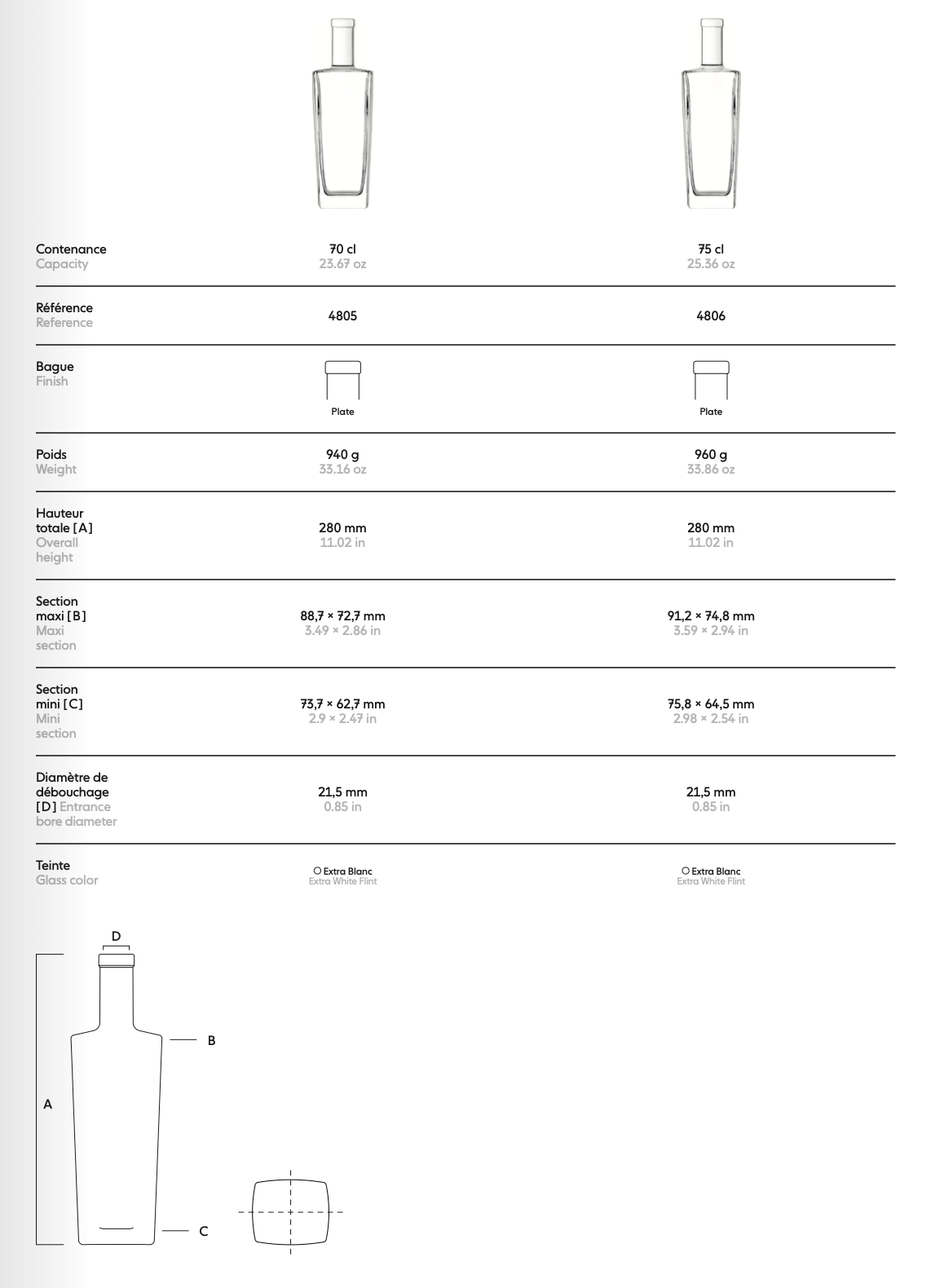
Reviewing standard shapes helps map your product to consumer expectations and factory capabilities. The Bartop or Cylinder shape is ubiquitous and reliable. It runs flawlessly on almost any filling line. The Bell shape offers a classic, soft profile but complicates labeling. Square and Rectangular bottles project strength and modernism but introduce corner-impact risks. The Flask shape leans heavily into heritage and portability. Map these shapes to specific spirit categories and your historical brand positioning.
You must evaluate the hidden costs of unconventional shapes. Palletization efficiency is a major factor. Wide or irregularly shaped bottles reduce the number of units per case. They also reduce the number of cases per pallet. This inefficiency drastically drives up shipping costs per unit. If a standard round bottle allows for 120 cases per pallet, but your custom wide-shoulder design only allows for 80 cases, your inbound freight costs just increased significantly.
Glass distribution and weak points require technical scrutiny. Sharp corners on square bottles create thin spots in the glass. This happens during the blow-molding process because the molten glass has to stretch further to reach the corners of the mold. Thin spots increase the risk of breakage during transit and automated filling. When a square bottle rotates in a star wheel, the corners become impact points. Ergonomics dictate the pourability factor. If a bartender cannot comfortably grip and pour the bottle with one hand, on-premise adoption will suffer immediately.
Liquid preservation and glass color involve critical technical considerations. Clear flint glass showcases natural liquid colors. This is essential for aged whiskies or vibrant liqueurs where the visual appeal drives the purchase. However, clear glass offers zero UV protection. You must evaluate colored glass options for light-sensitive liquids. Amber, green, frosted, or black coatings protect botanical-heavy spirits. Gin, absinthe, and delicate vermouths require protection from photo-oxidation and flavor degradation. UV exposure can strip the color and alter the flavor profile of a botanical spirit in a matter of weeks on a sunlit retail shelf.
Overall value influencing factors depend heavily on upfront tooling costs and production minimums. Custom molds require significant capital expenditure. You must pay for design, 3D modeling, prototype molds, and final production molds. Compare typical minimum order quantities carefully. Stock bottles often require only one or two pallets to get started. Custom runs frequently demand tens of thousands of units per order to justify the machine setup time at the glass plant.
Lead times directly impact supply chain resiliency. Custom glass often takes four to eight months from concept to delivery. You have to account for mold cutting, sample approval, mass production, and ocean freight. Stock glass offers near-immediate availability from domestic warehouses. You must discuss the risk of supply chain bottlenecks. Relying on proprietary molds held by a single overseas manufacturer introduces substantial operational risk. If that factory experiences a shutdown, your entire brand stops bottling.
The hybrid approach offers a powerful middle ground for growing brands. You can utilize standard stock bottle shapes to keep costs low and avoid mold fees. You achieve differentiation through advanced decoration techniques. Custom embossing, unique closures, ceramic printing, frosting, or custom decals transform a stock bottle into a premium, proprietary package. This allows you to scale production quickly while maintaining a distinct visual identity on the shelf.
Evaluation Metric | Stock Glass Bottles | Custom Glass Bottles |
|---|---|---|
Upfront Tooling Cost | Zero | High (Design, Prototyping, Molds) |
Minimum Order Quantity | Low (1-2 Pallets) | High (20,000+ Units) |
Lead Time | Fast (Immediate to a few weeks) | Slow (4-8 Months) |
Brand Differentiation | Requires creative labeling/decoration | High proprietary brand equity |
Supply Chain Risk | Low (Multiple distributors available) | High (Tied to a single mold/factory) |
Features-to-outcomes mapping starts with neck finishes and closure systems. Define your standard neck finishes early in the design process. Common options include GPI continuous thread, ROPP aluminum caps, and Cork or Bartop finishes. The internal bore diameter of the neck strictly dictates closure selection. Proper sizing prevents leakage, evaporation, or cork push-out under atmospheric pressure changes. If the bore is too wide, the cork will slip. If it is too narrow, the cork insertion machine will shatter the neck.
Implementation risks often center around label panel geometry. The label panel is the flat or gently curved surface area where labels are applied. Compound curves or heavily tapered bodies introduce severe risks. They cause labels to wrinkle, flag, or tear on automated labeling machines. A machine applies a label in a perfectly straight line. If the glass curves away from that line, the paper has nowhere to go but fold over itself. Always consult your label printer and co-packer before finalizing a curved design.
Weight and center of gravity affect line speed and stability. Heavy-bottomed bottles feature a thick glass punt. This lowers the center of gravity, which generally improves stability on the line. However, poorly distributed weight can cause tipping on high-speed conveyor belts. When a bottle transitions from a conveyor to a rotary filler, a high center of gravity will cause it to wobble and jam the machine. Ensure your bottle design moves smoothly through star wheels, transition plates, and accumulation tables.
Implementation mitigation requires rigorous prototyping and line testing. Mandate the use of 3D-printed or lucite prototypes. These models allow you to test ergonomics and visual scale in the real world before cutting steel molds. Detail the necessity of ordering a sample pallet of glass. Run these samples through your actual filling, capping, and labeling equipment before signing off on mass production. A physical line trial exposes flaws that a digital rendering hides.
Avoid common production traps that destroy margins and halt production. Thermal shock cracking occurs when glass breaks during hot-fill or steam-sanitation steps. This happens due to poor thermal shock resistance in the glass composition. Label panel recess depth failures cause scuffing. Paper labels rub together during transit because the panel is not recessed enough to prevent bottle-to-bottle contact in carton grids. Out-of-round neck bores feature minor inner diameter variances. These variances cause cork slippage or micro-oxygenation issues, ruining the liquid inside.
Conduct a thorough manufacturer audit before issuing a purchase order. Here are six questions you must ask your glass supplier:
What are your strict dimensional tolerances for height, diameter, and neck verticality?
What is the thermal shock resistance rating of this specific glass model?
Do you provide matching, validated closures, or must we source corks and caps separately?
What is the minimum top-load pressure threshold for pallet stacking?
What decorating capabilities are performed in-house versus outsourced?
What is your lead-time buffer and inventory holding policy for custom runs?
Quality control protocols must be established early and enforced strictly. Define acceptable defect rates in writing with your supplier. Implement inbound inspection procedures for every glass delivery. Pull random samples from multiple pallets and measure them with digital calipers. Catching a dimensional variance before the bottles hit the filling line saves thousands of dollars in wasted product, broken glass, and lost line time.
To ensure a successful packaging rollout, take the following actionable steps:
Audit your existing filling and labeling equipment to define strict dimensional constraints before starting the design phase.
Order a sample pallet of your chosen glass and run a full mock-production test to identify line bottlenecks.
Calculate your total landed cost, factoring in freight inefficiencies and projected breakage, rather than just the unit price.
Verify the internal bore diameter tolerances with your closure supplier to prevent leakage and evaporation issues.
A: The 750ml size is the historical standard for the US market, while 700ml is the standard for the EU and UK. Recent US regulatory changes now allow 700ml bottles, making it easier for brands to use a single global size and streamline their supply chain.
A: Glass manufacturing requires massive, continuous-fire furnaces. Stopping and starting production lines to swap custom molds is expensive and time-consuming. Manufacturers require large runs to make the setup process economically viable and absorb the downtime costs.
A: Wide, angular, or irregularly shaped bottles take up more physical footprint. This reduces the number of bottles that fit into a standard case and the number of cases that fit on a pallet, directly increasing the freight cost per unit.
A: The label panel is the specific flat or gently curved area on the glass designed to receive a label. If this area has compound curves or tapers, automated machines will struggle to apply labels without wrinkling, flagging, or tearing them.
A: The internal bore diameter must precisely match your chosen cork or closure. If the tolerance is too loose, the bottle will leak or the spirit will evaporate. If it is too tight, the cork may break or push out under pressure.


